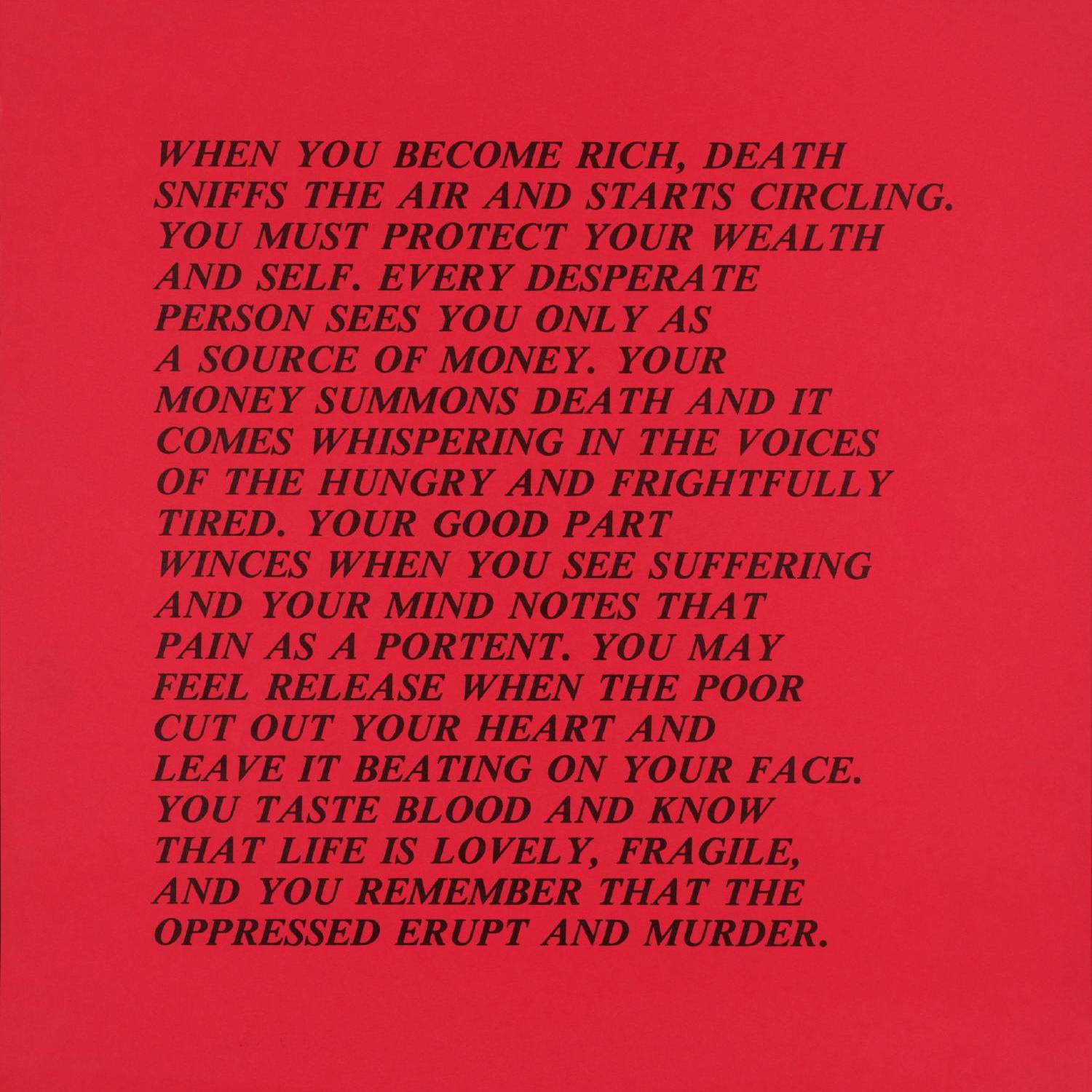
The American artist Jenny Holzer holds a place of significance in my mind after our trip to London, after further research her work can be found on the street as well as in the galleries. The way she provides such deep and meaningful statements which are short but then entail a huge problem or issue and retain an impact and force to the piece is captivating. For the viewer it promotes thought on the issue provided, it asks the viewer to deconstruct its outer shell, especially of her beautiful light installations, and thus to stop and think about what the pieces are entailing as part of the bigger picture. The fact that words are central to her work highlights the importance of speaking about these problems, all humans are able to communicate through a form of words. Therefore her work highlights the universal nature of the issues and the necessity of discussion concerning them. These words don’t always express her own views and may contradict each other, which demonstrates how Holzer considers the broader image rather than her own opinions. Rather than focusing the work on her own opinions she asks for and leaves room for a diversity of opinions.
In Holzer’s own words:
‘ wanted a lot simultaneously: to leave art outside for the public, to be a painter of mysterious yet ordered works, to be explicit but not didactic, to find the right subjects, to transform spaces, to disorient and transfix people, to offer up beauty, to be funny and never lie.’
In her early career her work featured on tshirts and posters which I believe is the most important of her work. This means that the messages which we wished to portray were closer to us in a more mundane situation, thus our thoughts are provoked in mere day-to-day situations rather than away from the street and the bustle of human life. There is something important about stopping in our daily routine, our enclosed life as an individual in our own bubbles and thinking about the bigger picture. It is exceedingly easy to get lost in a mist of our own thoughts and in the pleasures of our own worlds, therefore encountering her bold statements in the street is something that should be a necessity to pull us out of this haze. This allows us to then consider the bigger picture and consider your own view, thus presenting another important piece to her work is the universal nature of it. As aforementioned, each viewer is invited to form their own opinion. An advantage of using words in her word, for the viewer to sit there and take the time to read it, even if it is brief it is still time taken to stop and consider the work. Thus before you have even thought about the meaning and the deeper side, you have already considered the surface of the piece, bringing an almost multifaceted understanding to her work.
One of the most interesting pieces for me was her bench with ‘Raise boys and girls the same way’ inscribed into the top. Holzer’s use of a bench, which is a functional object demonstrates the way that she brings her work into the everyday lives of the viewer. The majority of the time, human curiosity will lead the viewer to read the message on top, and thus she gets us to participate in the process of her work. The thought process of the viewer is as much a part of her work as the object. Written on the Tate website is that the messages on the benches are ‘excerpts of poems by the acclaimed Polish author, Anna Świrszczyńska, who wrote about her experiences as a nurse and member of the Polish Resistance during the Second World War.’ and that ‘Holzer works with many kinds of stone and she carefully selects material that complements the engraved texts.’. Using the work of a poet, who again used words to communicate and demonstrate issues, poetry has a similar thought process to Holzer’s own work, the stop and read and then think deeper. Holzer creates layers of women expressing issues through words, is there a significance in this comparison? Throughout the ages it is clear that women have not had the freedom to express their opinions and thus when they were allowed to write and become educated the strength and meaning of their words has such a great meaning. Such as Aphra Behn, the first published British female playwrite, words gave her power. Her revision of Killigrew’s Thomaso is a triumph of female words, taking a male play in a male dominated profession, rewriting it and it being more successful is her own way of saying that women are able to be just as good as men, if not better. 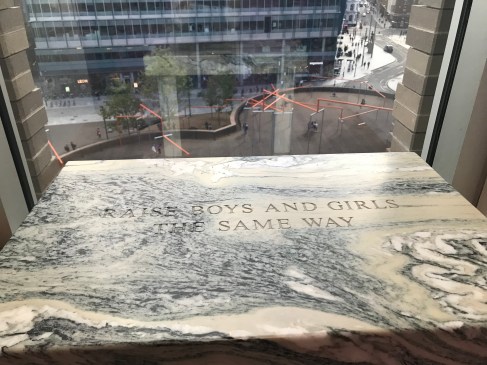
 Holly Telfer FAD